Beth: Chapter 10
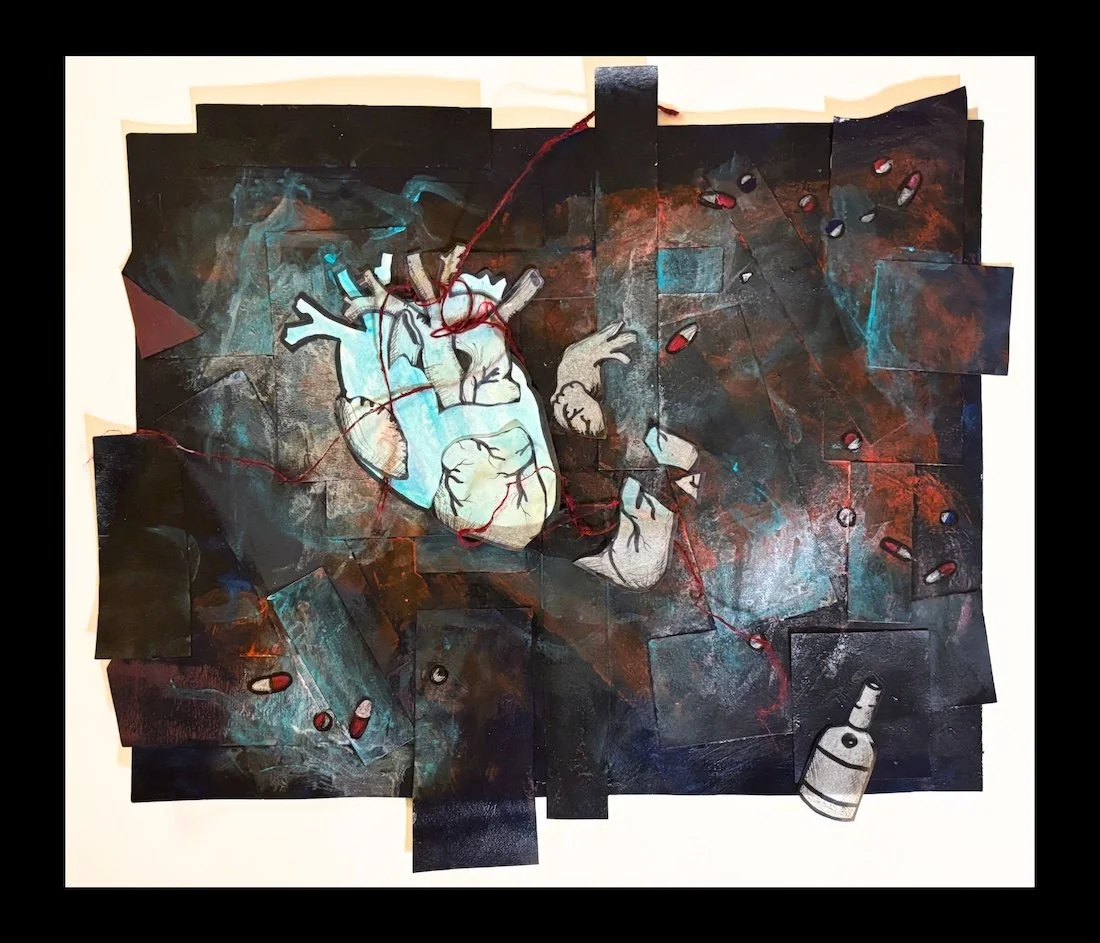
Immerse
Mixed media: collage, acrylic paint, translucent paper, ink, thread
Marigny Jian DeBlanc
Story by Xavier (they/them)
Adoptee, 27
Nanchang Project Volunteer
From Unknown, Jiangxi; Living in Lekwungen and WSANEC Territory, Victoria, B.C., Canada
-
This story is deeply personal. It is a reflection of my journey—painful, messy, and sometimes raw, yet slightly fictionalized. All names have been changed to protect the privacy of those involved with one exception: the titular character who is referred to by my original adoption name. I have chosen to share this story because I believe in the power of truth to heal and connect us and because I wish to illustrate the reality of growing up in a difficult adoptive home.
You may encounter moments of grief, trauma, and abuse within these pages. For some, these moments may be difficult to read. Please know that I include trigger warnings where appropriate, and I encourage you to take care of yourself as you engage with this story– if you so choose.
While my experiences have shaped much of my life, this is also a story of survival, resilience, and the ongoing journey toward wholeness. It is meant to offer solidarity and hope to those who may feel isolated or broken in their experiences as adoptees.
You are not alone.
If you or someone you know needs support, please consider reaching out to a trusted friend, counsellor, or helpline. I have included links below and will continue to with each chapter as they are released.
Thank you for reading and holding space for this story.
With gratitude,
Xavier Huang
-
Beth: A Love Story
Chapter 10
TW: Self-harm, suicide attempt, substance abuse
If you or someone you know is experiencing a mental health crisis, call or text 988. Available in the US and Canada.
Eric is dead, and Beth has died with him. Like the dawn of a new age, it happened slowly at first and then all at once. Yu is a shell, she is an orphan, she is nothing. Without the man who defined her life, who destroyed her before she had a chance to begin to live, Yu is lost. She wishes she had died in his stead.
Before Eric died, Yu nearly died too. She spent the years before Shanghai and after, in and out of the hospital, plagued by impulses to hurt herself, to stop the ever-present pain and the thoughts that demanded to be known.
Two weeks before her twenty second birthday, living became too much. She swallowed three bottles of pills, washed them down with vodka, and laid upon the ground while her favourite song played on a loop.
Her consciousness faltered. Through the dark, she remembers images of a paramedic, yellow lights, a cross hanging from a chain on someone’s neck. In the hospital, her heart stopped, and she felt herself drifting into a deep darkness. Like sinking to the bottom of a pool, the fall was warm, comfortable; suddenly, she realized how easy it would be to die.
But she had lived, and waking up was the most painful moment of all.
Yu told Helen, but no one else. She knew Lucy would not care, and when she later found out, she did not. She knew that Eric would be angry, would arrive to belittle her and sling profanities the way he had the first time she had ended up at the hospital. So, when she was released, she lived with a friend for a month and drowned herself in drugs and alcohol.
When Eric died, it was a spring day. The sun was shining and the air smelled of flowers and freshly cut grass. Clouds drifted across a light blue sky, their reflections shimmering in drying puddles along the street.
Before he was diagnosed with cancer, Yu and Eric had been fighting. For the first time in her life, she told him the truth—or as close to the truth as she could bear.
Eric did not understand why she was so unwell. He could not rectify her constant hospital visits; he refused to see her in the psych ward. He blamed her illness on her birth parents and accused them of being alcoholics, mentally unwell. And when Yu had finally screamed at him that it was not them, that the good parts of her were because of them, and everything bad, everything evil, she had learned from Eric, he had told her she was ungrateful and walked away.
Not even three weeks after their fight, Eric began to die, but first he started to forget. He called her one night, as she sat in a bar getting drunk. His voice was thin, he struggled to speak, and he begged her to meet with him so that he could apologize and explain.
There were no options for Yu. She had no time for reconciliation or repair. She forgave him because she had always loved him, and because it was the only thing she could do. And slowly, the legacy of anger was stripped from Eric and Yu took it upon herself instead.
He forgot her name first, forgot details about her and her life. He could not remember her friends, nor the last time she had visited. He cried constantly, making up for the years of his life where all he expressed was coldness and rage. And Yu had never loved him more than when he was unwell. Death made him human in a way that his life of success never could.
When Eric died, Beth and everything that she had been, died with him.
Yu woke up the next day, smoked a joint, and cried that she had been left behind.
To access licensed US mental health professionals who identify as adoptees and work with adoptees/adoptive families visit growbeyondwords.com/adoptee-therapist-directory.
-
Immerse
Mixed media: collage, acrylic paint, translucent paper, ink, thread
Marigny Jian DeBlancBuilt from layered materials and uneven edges, Immerse invites close attention—its rough textures and fragments revealing more the longer one looks. At the center, a red thread binds a heart that appears both fragile and enduring, asking whether repair and pain can coexist. Midnight blues and blacks envelop veins of pale blue and deep red, evoking the pulse of a body caught between numbness and awakening. Scattered within the layers, small shapes—a pill, a bottle, faint inscriptions—echo the artist’s reflection on Yu (Beth)’s descent into darkness and her body’s slow surrender. Through its tactile construction, the piece captures that liminal space the artist describes: a drift between life and death, unraveling and the first, uncertain act of mending.
-
Marigny Jian DeBlanc (she/her) is an adoptee and mixed media artist from Wuzhou, Guangxi and currently based in New Orleans. For DeBlanc, art was a first language—a way to navigate and make sense of a new world shaped by transition and complexity. Through her interdisciplinary practice, Marigny explores the tension between the known and the unknowable using art to explore reflection and reconciliation.
Marigny is the artist and illustrator of Book 1, Chapter 3; and Book 2, Chapter 10 of Beth. To learn more about Marigny and the other artists of Beth, read about them here.
-
Xavier (they/them) is an adoptee from Jiangxi who now lives on the unceded territory of the lək̓ʷəŋən and W̱SÁNEĆ nations (colonially known as Victoria, B.C., Canada). X is a prolific writer and enjoys creative non-fiction, fantasy, and fiction writing. Through their work they explore their identity as an adoptee, parse their lived experience, and explore what it means to be human. They joined the Nanchang Project in 2023 and cherish the community they have discovered amongst the volunteers and adoptee community generally.
The views expressed in blog posts reflect those of the authors and do not necessarily represent the shared views of The Nanchang Project as a whole.
Our blog stories come from readers like you!
We invite you to send us your own story to share. We accept submissions from anyone whose life may have been touched by Chinese international adoption including, but not limited to: adoptees, adoptive families, birth families, friends, searchers.
Details in the link below!