A Collective Reflection: What Being AANHPI Means to Us
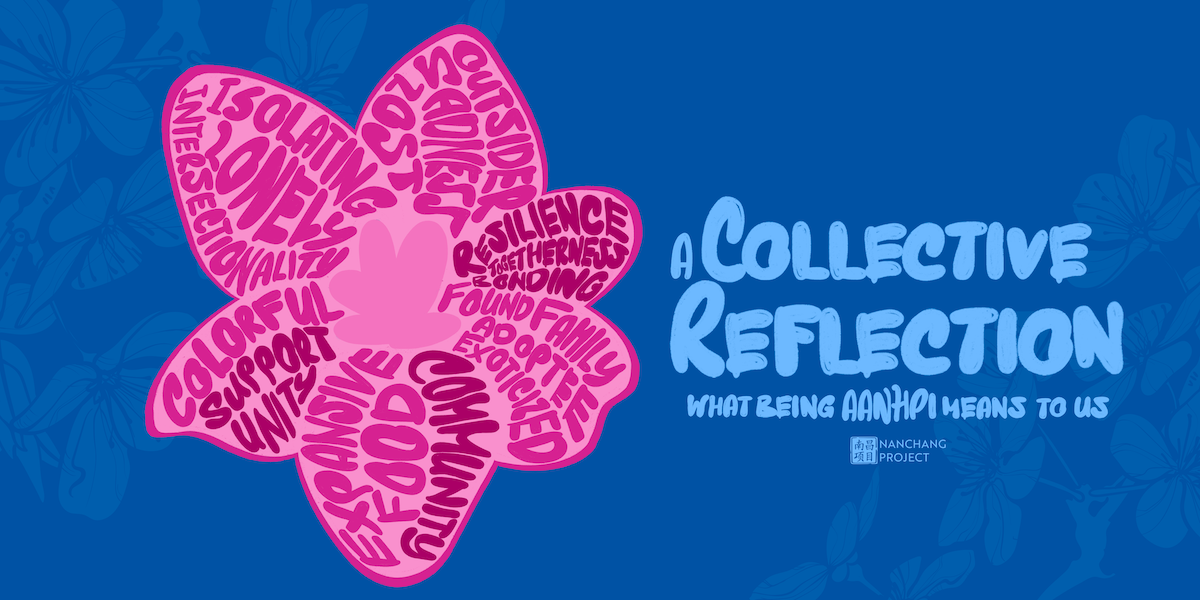
Artwork by Taylor DePetris.
By Nanchang Project
Words collected from Nanchang Project (NCPT) supporters and community
Reflections written by NCPT volunteers Jenna M, Katie L, Phoenix V, and Taylor D
The month of May is a celebration of Asian American, Native Hawaiin, and Pacific Islander Heritage. We all navigate this uniquely as we encounter the various facets of Asian-ness differently in our lives; the Asian-American community is deep and diverse, and our corner of the AANHPI community, as adoptees, is a truly singular one.
At the start of the month, we asked you, NCPT supporters and community, to come together to create a live AANHPI Month Word Cloud by sharing three words to describe the AANHPI experience and/or community. As we wrap AANHPI Month, our Word Cloud has been translated into an expanded reflection, written by NCPT adoptee volunteers.
With thoughtful consideration informed by personal experience, we offer an expanded reflection on several themes poured into our word cloud by you: food captures the intimate ties between culture and self through taste, memory, and tradition; resilience stands as both a process and outcome of navigating adversity; intersectionality provides the language to understand how multiple identities converge to shape one’s place in the world; and an adoptee offers a meditation on the distinct space adoptees occupy within our communities, where the gifts of opportunity and love are often held alongside feelings of displacement and being an imposter.
Among these layers, there is joy—found in flavor, memory, connection, and the many ways we make meaning of who we are. We carry forward not just stories of struggle, but also stories of celebration, care, and creativity.
I’ve always considered food to be an important aspect in any culture (at least for a foodie like me) as it typically brings people together to eat. Not only that, but it's a sneak peak into the daily lives of the people from that country. Food may be eaten on special occasions, times, and seasons, this is all a part of someone's culture and way of living. As a Chinese adoptee who grew up outside of Asia, I often feel disconnected from Chinese culture (my culture?). I didn’t grow up understanding all of their traditions, knowing all of the Holidays, or some of the traditional foods.
I grew up in a predominantly white area, so it was hard finding authentic, traditional food. Though my parents had always tried their best at having a variety of Asian meals (we have many chopsticks at home as well as a rice cooker lol) it was hard to not wonder what it would be like to eat traditional Chinese food, cooked by someone who grew up eating it. Someone who learned how to cook these foods from a relative, and not from recipes online. This especially became difficult for me as I had to teach myself how to wrap dumplings, while most Asian people I saw in the media grew up learning how to do it as kids, taught by their relatives. Now that I’m older and live away from home, I have begun to learn (according to Google) staple meals such as egg drop soup and tomato egg stir fry.
As I live in a bigger city than the one I grew up in, there is a much larger Asian community. This means that there are many businesses that celebrate Asian holidays and create events around them. This weekend for instance is the Asian Festival of Food and Culture where many Asian business owners from the area come for 4 days and sell food, crafts, play music and have special presentations. I don’t remember a time where I’ve seen so many Asian people at once, and its exciting. These types of events excite me and I look forward to being able to try new food and explore my culture with the ever growing Asian community.
‘Food’ reflection by Jenna M.
In many ways, reconnecting with food is also an act of resilience—a quiet, joyful reclaiming of culture, identity, and belonging. Whether it’s learning to cook dishes we didn’t grow up with or finding community through shared meals, these small moments nourish more than just our bodies. They remind us that healing and growth often begin in the everyday.
And just as we find ourselves through flavor and tradition, we also find strength in the stories we carry—especially the ones shaped by challenge and change.
Resilience is both a process and an outcome—the ability to adapt and grow through difficult or challenging life experiences. As an adoptee community, we’ve shown resilience time and time again. For international adoptees, this journey began before we could even form words. As children, we adapted to unfamiliar environments and identities. As adults, we’ve revisited those early experiences, reflecting on what adoption has meant for us and how it has shaped us.
To me, resilience isn’t just a celebration of what we’ve overcome—it’s an acknowledgment that the path hasn’t been easy. It’s been hard. We've wrestled with sadness, confusion, anger, and anxiety. And still, we made it through—stronger, wiser, more compassionate.
We are beautiful people, shaped not just by our struggles, but by our strength.
Way to go, us.
Way to be resilient.
‘Resilience’ reflection by Taylor D.
Our resilience doesn’t exist in a vacuum—it’s shaped by the layered identities we carry and the ways they intersect. For many adoptees, understanding ourselves means navigating not just one narrative, but many at once. It’s in this complexity that we begin to find language for who we are and where we belong.
As stereotypical as it is, I first learned about intersectionality at my college in an Asian American studies course to fulfill a gen ed credit.
I was interested in Asian American history ever since I had to do an 8th grade report on the immigration of “my family” to the US. I intentionally chose to study how Asians immigrated through Angel Island instead of doing a report on my adoptive white family immigrating through Ellis Island because I felt more inclined to learn the struggles of Asians in the US, struggles that seemed to vaguely affect me but I had no clear idea yet how.
While I viewed this as history that happened to people who look like me, my Asian American studies course finally gave words to feelings I’ve had about occupying multiple identities.
Yes, I am Asian American but I am also a transracial adoptee (TRA) who was raised and conditioned in a white environment. I do not feel like an immigrant but my legal documents reflect that I am. My intersecting identities seem both at odds with each other and seem to afford me certain privileges.
Intersectionality has taught me that I am far more connected to Asian American and BIPOC communities than I ever felt as a child. The invisible strings that hold us together as ethnic Asians in the US are both comforting and saddening. I feel comfort in that I have some shared experiences with non-adopted Asians but I also feel imposter syndrome in that I don’t feel like I am fully a part of their “in group.”
But intersectionality has also influenced how I view the space I occupy in the world and drives my advocacy for Asian adoptees, Asian diaspora, and BIPOC communities. Asians are not a monolith and by sharing my experiences as a Chinese TRA, I can change the dichotomies that try to keep our communities separate.
‘Intersectionality’ reflection by Katie L.
Intersectionality helps us name the space we occupy—often in between. For adoptees, that space can feel especially complex, shaped by both separation and connection.
Being an adoptee is a layered identity: complex, multifaceted, always evolving. For me, what I once thought was irrelevant to my sense of self has grown into something deeper and more reflective. Adoption means growing up in the in-between: severed from my roots, language, and culture, yet raised with access to privilege and opportunity. That privilege offered me certain doors, but not a sense of belonging, as I was often marked by difference. Within Asian communities, too, I’ve often felt like an outsider, and even an imposter with a strong sense of shame. And yet, love (complicated but real) has come from many places, including both the family that raised me and the one I’ve reunited with. Those experiences, with all their layers, continue to shape me. The word “adoptee” carries weight: it holds grief and grace, loss and resilience, anger and understanding, questions and discovery. What binds adoptees is a shared understanding of complexity, and within that, a strength that comes from learning to hold many truths at once.
‘Adoptee’ reflection by Phoenix V.
AANHPI Month creates both opportunities and challenges in sharing in the joy and beauty of one’s heritage and also confronting the dichotomous nature of being an Asian person in a place where being so has historically been fraught with difficulty and division, and continues to present challenges—some long endured, others newly emerging—shaped by generations of “otherness,” expectations, and the ongoing struggle to belong in a place that both embraces and erases.
The common thread that we all share is the ability to be in community with one another—to lift each other up, to celebrate the richness of our identities, and to find joy in the spaces where our stories meet. In that togetherness, there is healing. There is power. There is laughter, love, and the radical act of belonging. Even in the midst of complexity, we create something beautiful when we show up fully ourselves, for ourselves and each other—together.
The views expressed in blog posts reflect those of the authors and do not necessarily represent the shared views of The Nanchang Project as a whole.
Our blog stories come from readers like you!
We invite you to send us your own story to share. We accept submissions from anyone whose life may have been touched by Chinese international adoption including, but not limited to: adoptees, adoptive families, birth families, friends, searchers.
Details in the link below!